Loading post
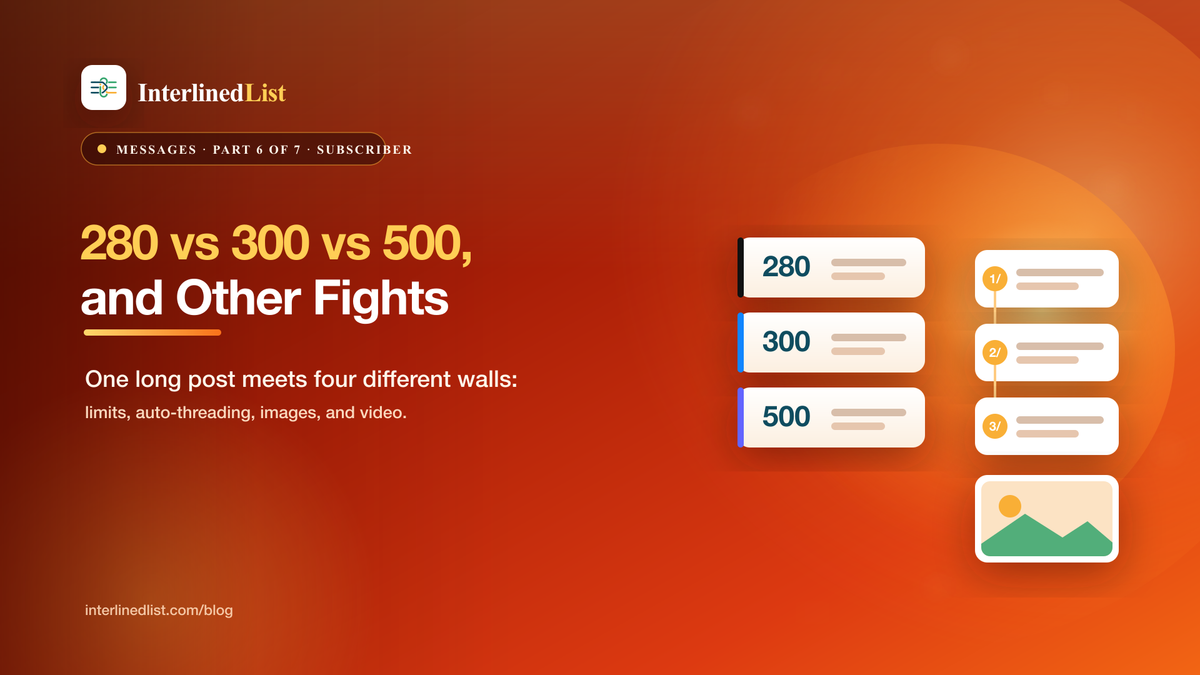
280 vs 300 vs 500, and Other Fights
2026-08-14
A single long post shown fanned out into a numbered thread on X, a single post on Mastodon, and a short thread on Bluesky
One 600-character thought, three different outcomes, decided by each network's own ceiling.
Part 6 of 7: A Field Guide to Messages
The creator from the last post is back, and he has a problem that is entirely of the internet's making. He writes a genuinely good 600-character update. He wants it on all four networks. But the four networks cannot agree on how long a post is allowed to be, and they never will, so somebody has to referee. That somebody used to be him, retyping and trimming per app. Now it is the app.
These are the real numbers, straight out of the code, not rounded for a slide: X/Twitter caps a post at 280 characters. Bluesky allows 300. Mastodon allows 500. LinkedIn allows so much more that you will basically never hit it from a micro-blog box. Four platforms, three different walls, one piece of text.
Threading, handled
Here is what the app does with that 600-character thought. For each network, it checks the text against that network's limit. If it fits, it posts as one. If it does not, it splits the text into a numbered thread that fits, and posts the pieces as a proper reply chain so they read in order on that network.
So the same update becomes a two-post thread on X, a single post on Mastodon (600 is over 500, so actually a short two-parter there too), a short thread on Bluesky, and one comfortable post on LinkedIn. The split prefers to break at sentence boundaries rather than mid-word, and it leaves room for the little "1/2" style counter so readers know there is more coming. He wrote one thing. Each network got the correctly-shaped version of it without him counting characters.
I want to be honest about the tradeoff, because splitting is never free of taste. A thought that reads as one clean paragraph in your head becomes two posts on X, and a two-post thread always loses a hair of punch versus a single perfectly-fit line. If a post absolutely has to land as one unit on X, the move is to write it under 280 in the first place, and the character counter on the box is right there to keep you honest. Automatic threading is the safety net, not an excuse to stop thinking about length.
Pictures and video ride along
Text is only half of most updates. Cross-posting carries media too, and this is the other piece behind the subscription wall alongside cross-posting and scheduling. You can attach up to eight images to a post, or a single short video, and they go out with the text to the networks you selected. Images get resized down automatically so you are not shipping a 12-megapixel camera dump to four APIs.
The composer with three images attached below the text and cross-post toggles active
Up to eight images or one video, attached once, carried out to every network you picked.
Same tier rule as everywhere else in the paid half of this series: media uploads, cross-posting, and scheduling are all gated together. Free accounts get plain text, replies, digs, and pushes; media and syndication are the Subscriber line.
The part that pushes and replies remember
There are two behaviors that only make sense once media and cross-posting are on, and they are the reason I keep calling the InterlinedList post the hub.
When someone pushes your cross-posted message, the push can mirror natively on the networks the original went out to: a plain push becomes a repost or a boost, a Push & Comment becomes a quote. It is not a fresh copy-paste of your words; it is the real reshare primitive on each platform, pointed at the real post.
And when you reply to a message that was cross-posted, your reply can follow it out to Mastodon and Bluesky, landing as an actual reply to the actual post over there, if you are connected to the original author on that network. The conversation does not get stranded on one island. The hub keeps the map of where every copy lives, and uses it.
None of this asks the creator to think about plumbing. He picks networks, he attaches an image, he posts, and threading, resizing, and mirroring happen underneath. What he notices is only that the sentence he liked showed up everywhere, correctly shaped, with the photo attached.
There is one axis left that we have only posted on: time. Everything so far happens the instant you hit post. The last piece is writing now and having it go out later, on a schedule, without you being awake for it.
Share this post
Subscribe for new postsSubscribe via RSS
We'll email you a summary and link when a new post goes live. Confirm via the email we send.